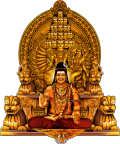
About Thondaimandala Samrajyam
Revelations by The SPH on the Antiquity of Kanchipuram
The history of Kanchi KAILĀSA Sarvajnapeeta begins with the puranical and historical happening of the incarnation of Devi Paraśakti on Planet Earth as Kamakshi Ammal. Devi Paraśakti, in playfulness, once covered the two eyes of Paramaśiva, the source of light for the cosmos. A period of darkness commenced where no growth was possible. The SPH revealed that this period is mapped to the Dark Age. Immediately, Paramaśiva opened His third eye and alleviated the world from this darkness. What was just a few moments in Paramaśiva’s eternal abode translated to thousands of years on Planet Earth. This history is documented in the Arunachala Purāṇa.
Devi Paraśakti, feeling responsible for the world’s sufering then requested guidance from Paramaśiva on how to raise humanity again.HetoldherthatasHisownextension, there was no need for any penance from her but if she chose, she can go to the city of Kanchipuram and perform austerities.
Devi Paraśakti, feeling responsible for the world’s sufering then requested guidance from Paramaśiva on how to raise humanity again.HetoldherthatasHisownextension, there was no need for any penance from her but if she chose, she can go to the city of Kanchipuram and perform austerities.
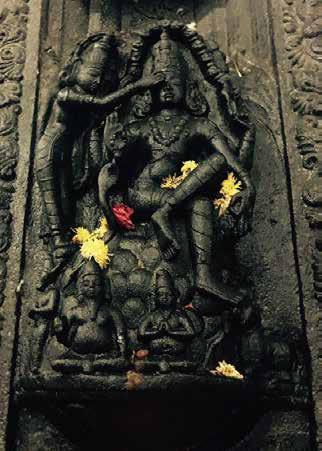
The above photo is a depiction of the Divine Mother covering the eyes of Paramaśiva
Archaeological Findings
Archaeological evidence suggests that there was an early human civilization during the Stone Age in the District of Chingleput – the same district as Kanchipuram in Tamil Nadu. The excavation site in this region unearthed scrapers and blades that were identifed with the Stone Age of early humans. In 1961, a well-shaped, handaxe of the mid- Acheulian type was discovered, as a marker of an advanced civilization that lived here in this period. Paramaśiva Himself was the founder and Ultimate Guru of this civilization. From these roots, the great Adi Shaiva Vellalar community and the Shaivism philosophy, culture, and lifestyle were born.
Just from archaeological evidence it is dificult to give a more precise date. The traditional stone age is accepted to be from 2.5 million years ago to roughly 6,000 BCE. While evidence from the Stone Age gives us a time period, more precise evidence is provided by our fore-fathers in the Hindu scriptures.
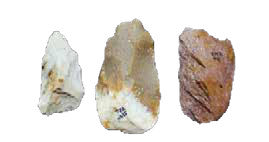
Stone Age Tools Found in the Kanchipuram-Chennai Area
Origins
Kanchipuram is the home of the Ekambareshwara Linga, one of the 12 Jyotir Lingas, powerful temple ecosystemworshipingŚiva,andtheland of the intense presence of Paramaśiva.
This is the place where Paramaśiva Śakti, the divine mother, is worshiped This is the place where Paramaśiva Śakti, the divine mother, is worshiped From Nandi, the tradition was passed
to Sanatkumara, then to Sathiya Jnana Darisanikal, and fnally to Paranjothi Munivar, who descended to earth and gave the tradition to Meikanda Thevar. After this, the lineage of Guru Maha Sannidhanams of the Thondaimandala Aadheenam began.
Under a sacred mango tree in Kanchipuram, Paramaśiva blessed Devi and the whole world by revealing the Kamika Āgama, the decrees for humanity to live an enlightened lifestyle. This same mango tree having died and come back for several generations is still surviving, and today worshiped as the presence of Paramaśiva Himself. Around the great tree, the temple of Ekambaranathar and the civilization was built.
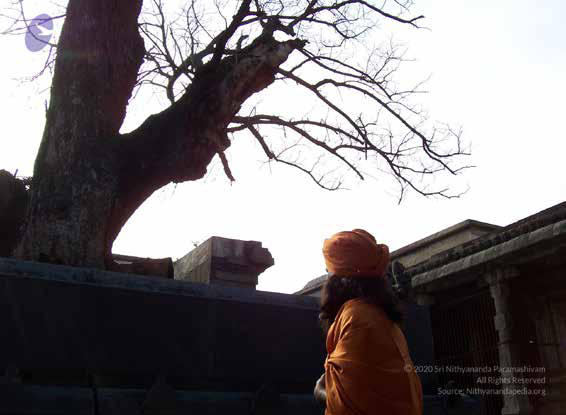
Photo of The SPH under the sacred Mango Tree shrine in the Ekambaranatha Temple during His royal tour (Vijaya Yatra) to Kanchipuram in 2004.
Works of Nandi
we can trace the works of another founder of the civilization: Nandi. Nandi came down along with Paramaśiva in order to assist the work of Paramaśiva and proliferate the science of Adi-Shaivism, the ultimate philosophy to experience oneness. Thus, he was the vehicle on which Paramaśiva reached the whole civilization. Nandi came down along with Paramaśiva in order to assist the work of Paramaśiva and proliferate the science of Adi-Shaivism, the ultimate philosophy to experience oneness. Thus, he was the vehicle on which Paramaśiva reached the whole civilization. Abhinaya Darpaṇa and Bharatārṇava are two of the well-known works of Nandi Himself. In these, among many subjects, he transcribes Paramaśiva’s own instruction for classical dance and music. He is referred also as Nandi-kesvara by Matanga Muni, who authored Brihadeshi and was the Guru of Sabari in Ramayana. Therefore, Nandi’s lifetime can be dated prior to the Ramayana era – approximately 5,800 BCE. This gives us the approximate year for the lifetime of Nandi to build the Hindu civilization after a period of darkness This time coincides with the end of the Stone Age, and the Neolithic Revolution, where agricultural developments allowed for more people to work on the land. This provided a stable source of food for larger communities, taking large strides away from the isolated tribal living and more toward civilizational harmony. Until today, the Adi Shaiva Vellalar Community is rooted in an agricultural lifestyle and being revived by The SPH.
Adi Saiva Vellalar Community
Thondai Mandala Shaiva Vellalars (the community from which hails The Supreme Pontif of Hinduism) already had their kriya mutts (kriya – rituals; mutts – monasteries) to carry out their kriya activities.
Each male and female was together receive Samaya Deeksha (formalinitiation into Adi Shaivism) between age 7 to 9, and receive the Vishesha Deeksha (Special Deeksha) before 16, before the time of marriage, being blessed with the right to offer Anmartha Śiva Puja (everyday personal puja ofering done by each one to the Śiva Linga he/she is initiated with).
If they are keen to lead a spiritual life, they would receive the Nirvana deeksha (one more spiritual initiation) and Acharya Abhishekam (ritualistic coronation to the spiritual seat).
The Adi Shaiva Vellalar community is also an agriculturally based community, with vocation primarily being related to farming or the trade of amenities. This lifestyle was also important to the tradition of Adi Saivism, as the foundation of their daily life was revolving around agriculture, which had a profound spiritual context. This same spiritual context and lifestyle is what The SPH is reviving in KAILĀSA.“Just like Goshala, if you work physically on the sand, prepare the soil, grow things, most subtle parts of your brain awakens. I think, every day every adheenavasi, should spend at least 1 or 2 hours. While you do that, keep your inner space in Oneness. Understand, let your inner space be with Śiva, body do the agriculture.”
“Unarvil saivamum, udalaal velaanmaiyum, Saiva velaanmaithvam”
Kings of Thondaimandalam
Kings of Thondaimandalam
The Thondaimandala Kingdom thrived over the years, being ruled by kings of the Pallava dynasty, Chola Sāmrājyam and Pandya Sāmrājyam, and excelled with advanced systems of learning and governance. Guided and initiated by the Guru Maha Sannidhanams of the Thondaimandala Aadheenam as the Raja Gurus, the devout kings upheld dharma and raised the fag of Hinduism across the region. Thondaimandala Kingdom has over 108 Śiva temples, some ofthemostancientandmostelusivetempleswithgrandarchitecture and sanctums that have been worshiped in for thousands of years, radiating that same energy.
The Pallavas Kings Circa 500 CE
- Established Kanchipuram as a center for learning
- Fortifed the city with ramparts, wide moats, well-laid-out roads and artistic temples
-
Introduced the cave style of architecture
-
Built the famous Kailāsanathar temple, Varadaraja Perumal Temple, the Iravatanesvara Temple
The Vijayanagar Kings
1361 – 1645 CE
- The Vijayanagar Kings redeemed Kanchipuram from the Mughals. Their dynasty was founded by Hakka & Bukka.
-
Historical kings Harihara (Hakka) and Bukka were heroes of the 14th century
-
They were kidnapped by the Delhi Sultanate and convertedto Islam, but they were deeply infuenced by Madhavacarya (Enlightened being and contemporary of Ramanujacharya) and reconverted to Hinduism.
-
They founded the administration of the Vijayanagara empire in Kampili.
-
Inscriptions in the Kailasanathar temple from 1364-1367 indicate the re-institution of Hindu rituals which were stopped during the Muslim invasions
-
The Vijayanagar dynasty would be the last defenders against the Muslim invasion, who rushed to protect Hinduism in every corner of the civilization when fire was being set to kingdoms, universities, Sarvajnapeethas and gurukuls on all sides.
Geography
- Kanchipuram
- Thiruchengode
- Malaysia
- Ruled by the Pallava dynasty, Chola Sāmrājyam and Pandya Sāmrājyam, and excelled with advanced systems of learning and governance.
The Hoysala Kings
-
Had a powerful garrison in Kanchipuram for a short time
- Thiruchengode
-
Heavily persecuted by the Mughals
The Chola Kings
- Continued the tradition of grand temple building
- Became an economic, military, and cultural power in Asia and artistic temples
- Spread Hinduism and Shaivism to Malaysia, Cambodia, and Indonesia
- Excelled in art, religion, and literature, bringing Tamil culture to a golden age
The First Islamic Invasions – 1311 CE
- In 1311, Malik Kafur, sent by Alauddin Khilji, invaded the city of Kanchipuram.
- Due to the ruthless persecution, the sacred rituals in the temple were forced to be abandoned.
- The Bahmani Sultanate barbarically invaded Southern India and annexed Kanchipuram.
Mughal Invasion & The Persecution of Kanchipuram
- The Golconda Sultanate took over Kanchipuram in 1672.
- It was later conquered by the Mughal empire led by Aurangzeb in 1687.
- The Mughals defeated the Marathas under Sambhaji, the elder son of Shivaji, in a battle near Kanchipuram in 1688.
-
During Aurangzeb’s rule, the deities of Varadaraja Perumal, Ekambareshwara and Kamakshi amman temple were transported to other temples of southern India in secrecy and not restored until after his death in 1707.
The Persecution of Kanchipuram
- The Golconda Sultanate took over Kanchipuram in 1672
- It was later conquered by the Mughal occupation led by Aurangzeb in 1687.
- The Mughals defeated the Marathas under Sambhaji, the elder son of Shivaji, in a battle near Kanchipuram in 1688.
- During Aurangzeb’s reign, the revered deities of Varadaraja Perumal, Ekambareshwara, and Kamakshi Amman were clandestinely moved to other temples across Southern India in an effort to protect them from his oppressive rule. These sacred deities remained hidden until Aurangzeb’s death, at which point they were finally restored to their rightful places of worship
British occupation of kanchipuram
- The British East India Company assumed indirect control over the region, and brought it under their control by 1794.
- They stole millions from temples, and the people’s taxes for their own benefit under the guise of colonization.
- They introduced acts like The Madras Hindu Religious and Endowments Act (1927). Though later reversed, it began the government interference into Hindu temples and monasteries, which still continues till date.
Due to decades long interference into the financials and management of monasteries and temples beginning in the British era, many have succumb to dilapidation
British Occupation of Thondaimandalam
- The British East India Company assumed indirect control over the region, and brought it under their control by 1794
- They stole millions from temples, and the people’s taxes for their own benefit under the guise of colonization.
- They introduced acts like The Madras Hindu Religious and Endowments Act (1927). Though late reversed, it began the government interference into Hindu temples and monasteries, which still continues till date.
A Kingdom Under Siege
Since the 227th Guru Maha Sannidhanam, there has been continuous interference into the succession process, diluting and degrading the sacred tradition originating from Paramaśiva. The only hope for the protection and revival of this ancient Kingdom was The SPH, who descended at the time that was most needed for Hindus.
| Attacks against Thondaimandalam Kingdom | Attacks against Tibetan Buddhists 11th Panchen Lama |
| 227th Guru Maha Sannidhanam, age 32, kidnapped by State government, and was never found again. The State claimed that his disappearance was voluntary withdrawal from his responsibilities as the aadheenam head. | The 11th Panchen Lama of Gelugpa school of Tibetan Buddhism, Choekyi Nyima went missing and his whereabouts were never known. |
This monastery – Thondaimandala Aadheenam – of the Kailaasa Paramparāgatha Adi Shaiva Sarvajñapiṭha Thondaimandala Sāmrajyam (Kingdom) is called Tirukkailaya Paramparai Thondai Mandala Aadheenam because it was established by Jnana Prakasar in the direct lineage of Paramasiva of Kailaasa (called Kailayam in Tamil)
Thondai Mandala Shaiva Vellalars (the community from which hails Bhagavan Sri Nithyananda Paramashivam) already had their kriya mutts to carry out their kriya activities. Each male and female was to get the Samaya Diksha (formal initiation into Adi Shaiva;) between age 7 to 9, and receive the special Diksha before 16, accepting Anmartha Shiva Pooja before marriage time and if they are keen to lead a spiritual life, they would receive the Nirvana Diksha and Acharya Abhishekam (ritualistic coronation to the spiritual seat). The Thondaimandala Shaiva Vellalar community was initiated into all such initiations in early days of the enlightenment ecosystem. To assist them in these activities, they needed a Jnana Mutt (enlightenment ecosystem ). They adapted this Adheenam (monastery) as their Jnana Peetham (spiritual Seat) and became its devotees through generations.
Our Mission
Thondaimandala Samrajyams leader The SPH Bhagavan Sri Nithyananda Paramashivam is giving a superconscious breakthrough to humanity, which is physically demonstrable through various power manifestations, scientifically measurable and stands the scrutiny of rational logic in hundreds and thousands of human beings around the globe.
Our Vision
- To revive and re-establish the VedaAgamas as a living Applied Science, giving the superconscious breakthrough that humanity is long waiting for in its evolutionary path.
- To pioneer a divine evolution, awakening human beings to their extraordinary powers (Shaktis) and powerful cognitions (from higher states of Consciousness), building the next level frequency of human body, mind, internal organs and intra organs (such as Third Eye).
- To empower humanity to manifest Superconscious powers at individual, societal and global levels.
- To re-create a Conscious world where the global issues at the climatic, economic, social, health and 2 humanitarian levels, cease to exist from their very root; turning the problems of poverty, hunger, violence, discrimination into powerful living through the experience of Oneness.
Thondai Mandala Shaiva Vellalars
Thondai Mandala Shaiva Vellalars (the community from which hails Bhagavan Sri Nithyananda Paramashivam) already had their kriya mutts (kriya – rituals; mutts – monasteries) to carry out their kriya activities. Each male and female was to get the Samaya Diksha (formal initiation into Adi Shaiva; Samaya – refers to the religion of Adi Shaiva; Diksha – spiritual initiation) between age 7 to 9, and receive the special Diksha before 16, accepting Anmartha Shiva Pooja (everyday personal puja each one does to a Shivalinga given to him after initiation) before marriage time and if they are keen to lead a spiritual life, they would receive the Nirvana Diksha (one more spiritual initiation) and Acharya Abhishekam (ritualistic coronation to the spiritual seat). The Thondaimandala Shaiva Vellalar community was initiated into all such initiations in early days of the enlightenment ecosystem. To assist them in these activities, they needed a Jnana Mutt (enlightenment ecosystem – a temple-monastery complex). They adapted this Adheenam (monastery) as their Jnana Peetham (spiritual Seat) and became its devotees through generations.
The Pontiffs of the Thondaimandala Aadheenam are picked from the Thondai Mandala Shaiva Vellalar community. The people of this community have made huge donations of lands and buildings at many places to this Mutt to make it a prosperous one. The history described above was seen in a book in possession with the 229th Guru Maha Sannidhanam (229th Pontiff).
Thondaimandalam and Thondaimandala Aadheenam
Kanchipuram in the State of Tamilnadu is primarily the Thondaimandala region. Hindus regard Kanchipuram in Thondaimandalam to be one of the seven holiest cities in India, the Sapta Puri (Sapta – seven; Puri – sacred place). In Hinduism, a kṣetra is a sacred ground, a field of active power, and a place where final attainment, or moksha, can be obtained. One of the Hindu Source Scriptures Garuda Purana says that seven cities, including Kanchipuram are providers of moksha (final attainment). The city is a pilgrimage site for Saivites and Vaishnavites. It has close to 108 Shiva temples. It was originally designed to stand for the ultimate Truths of Adi Shaiva and celebrate these Truths through its temples, culture, people and lifestyle.
The Guru Maha Sannidhanam (Pontiff) ruled this Adi Shaiva Kingdom from the Thondai mandala Aadheenam. Paramaśiva is the worshipped deity in this Aadheenam.
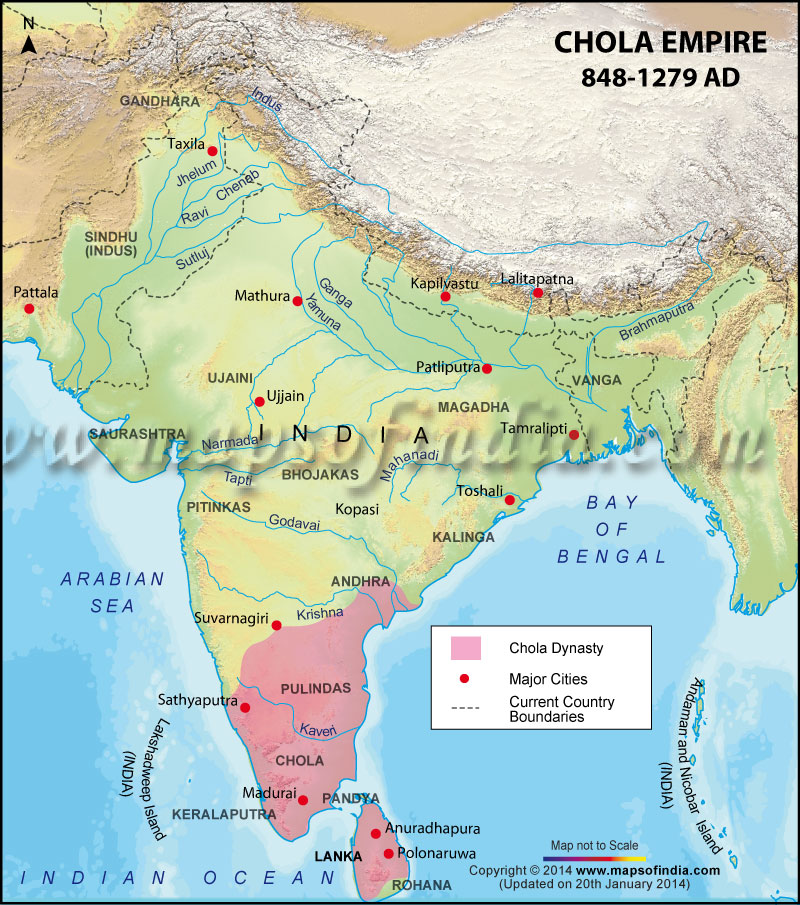
Chola Dynasty in 848-1279 AD of which Thondaimandala was a part
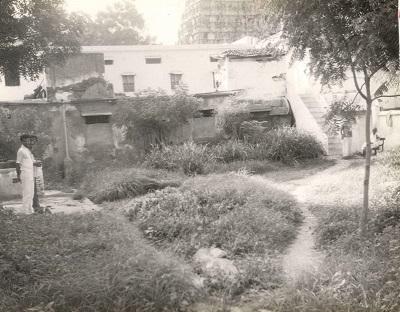
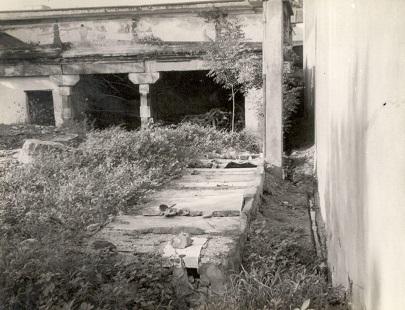
Pictures of the ancient Thondaimandala monastery
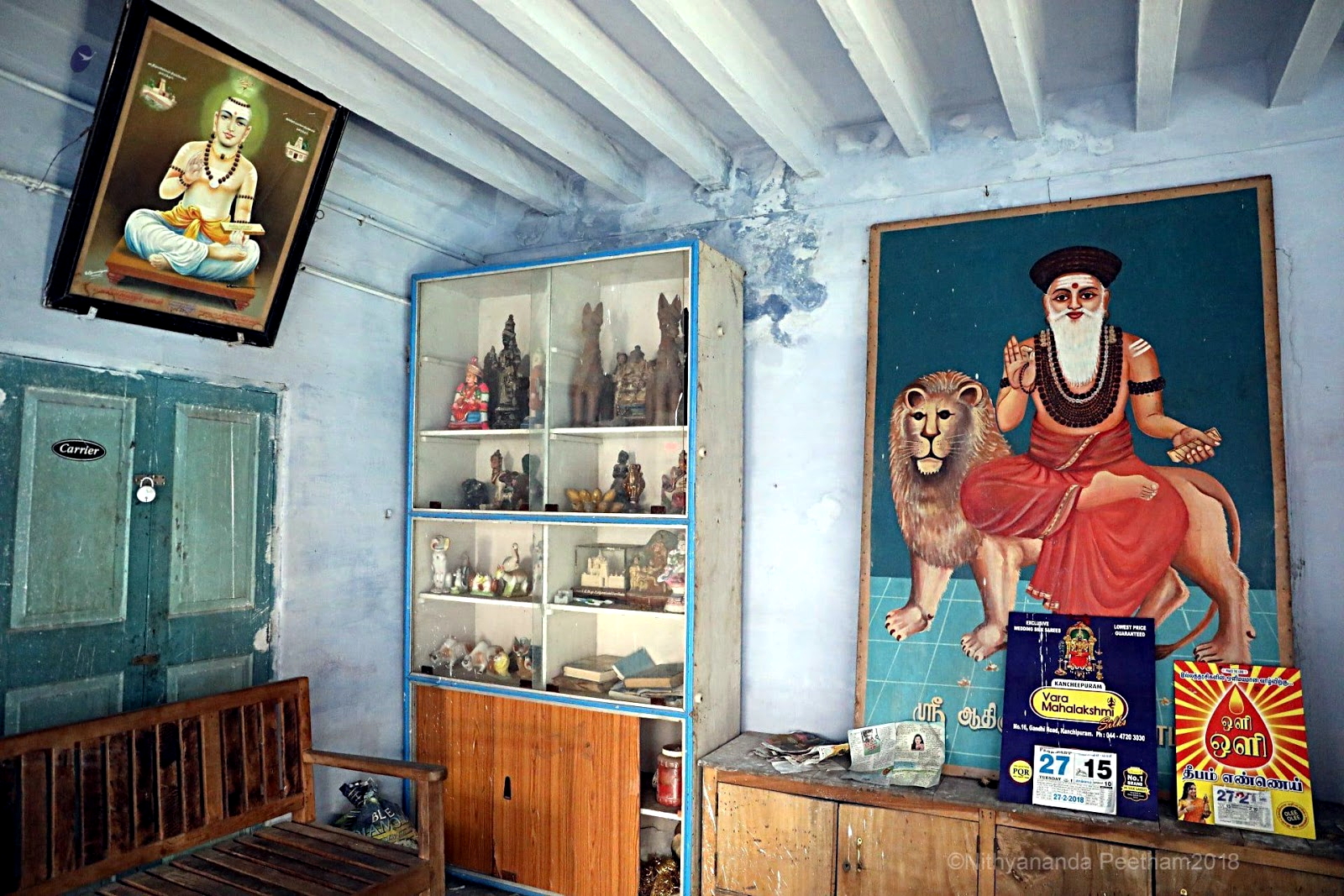
Pictures of the ancient Thondaimandala monastery
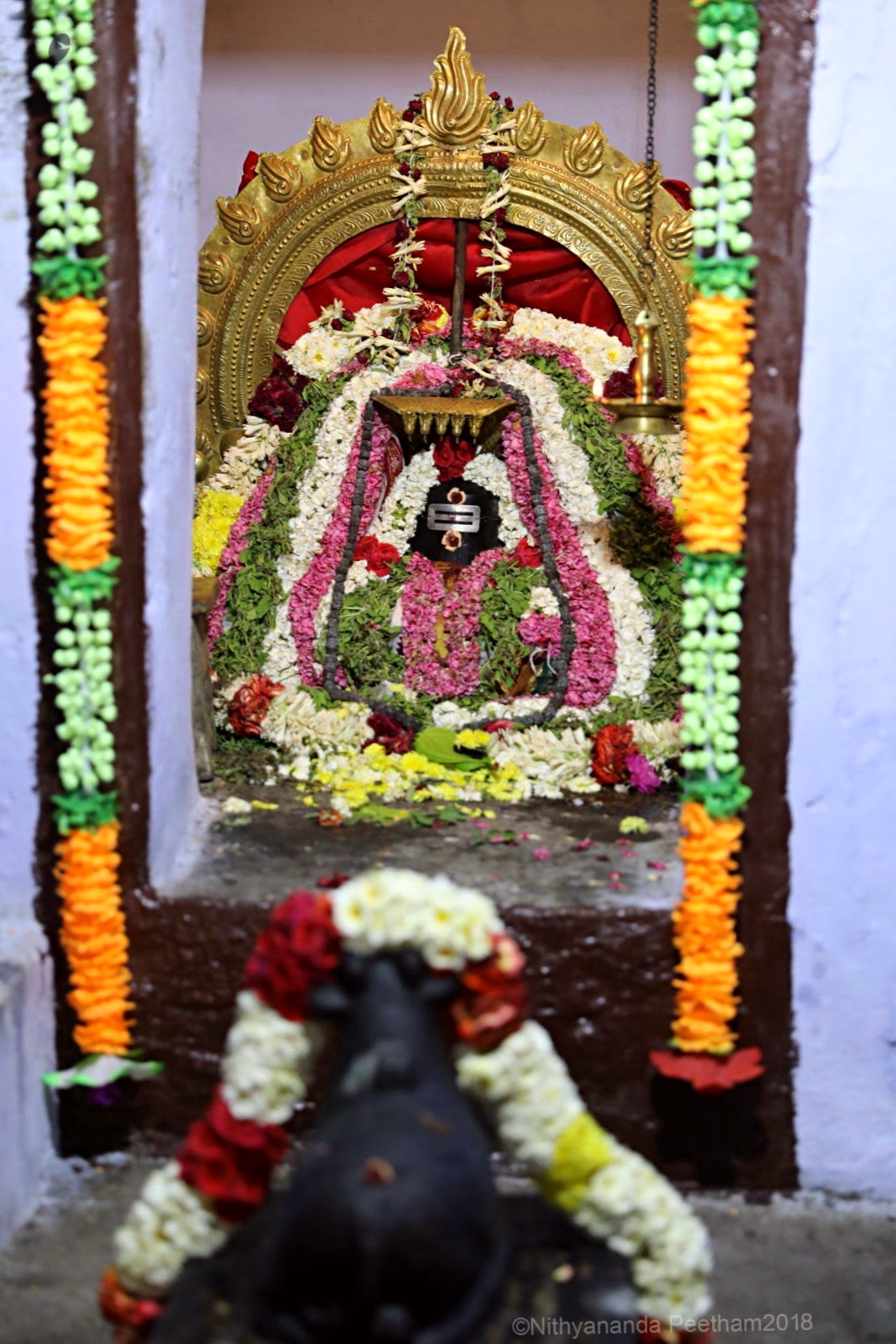
The presiding deity of Paramaśiva in the monastery’s temple.
Glory of Thondaimandalam
Padikasu Pulavar
Padikasu Pulavar is a Tamil poet who had lived during the late 17th and early 18th centuries. He was a native of Kalandai in Thondaimandalam. He was famous for authoring Thondaimandala Sathagam (sathagam is the name given to a composition containing one hundred verses) a poetic collection written in praise of Thondaimandala Vellalars or agriculturists of the Thondaimandalam region.
He was a court poet of Raghunatha Kilavan, first Sethupathi (Ruler) of Ramnad, South India. Sri Ramalinga Swamigal has written a fine commentary on the invocatory song of Padikasu Pulavar’s book Thondamandala Sathagam.
Xuanzang
A Chinese traveller who visited Kanchipuram in 640 CE, recorded that the city was 6 miles (9.7 km) in circumference and that its people were renowned for their bravery, piety, love of justice and veneration for learning.
Enlightened Beings and Power Manifestors of Thondaimandalam
In early days before the persecution of Kailaasa (ancient India where the civilization itself was a highly conscious and evolved one), there were enlightened beings, Siddhars, Munivars, Rishis, etc who manifested spiritual powers and kept the entire enlightenment ecosystem alive through their contributions and spiritual initiations. Below are a few such beings from ancient Thondaimandalam.
Saint Sekkizhar
Sekkizhar (Tamil: சேக்கிழார்) was a poet Saint and a contemporary of King Kulothunga Chola II in the Thondaimandalam region. He compiled and wrote the Periya Puranam (Great Story or Narrative) in 4253 verses, recounting the life stories of the sixty-three Adi Shaiva Nayanars, the enlightened devotees of Paramashiva. Sekkizhar himself was revered as a poet and Saint and his work, the Periyapuranam became the twelfth and final book of the sacred Saiva canon.
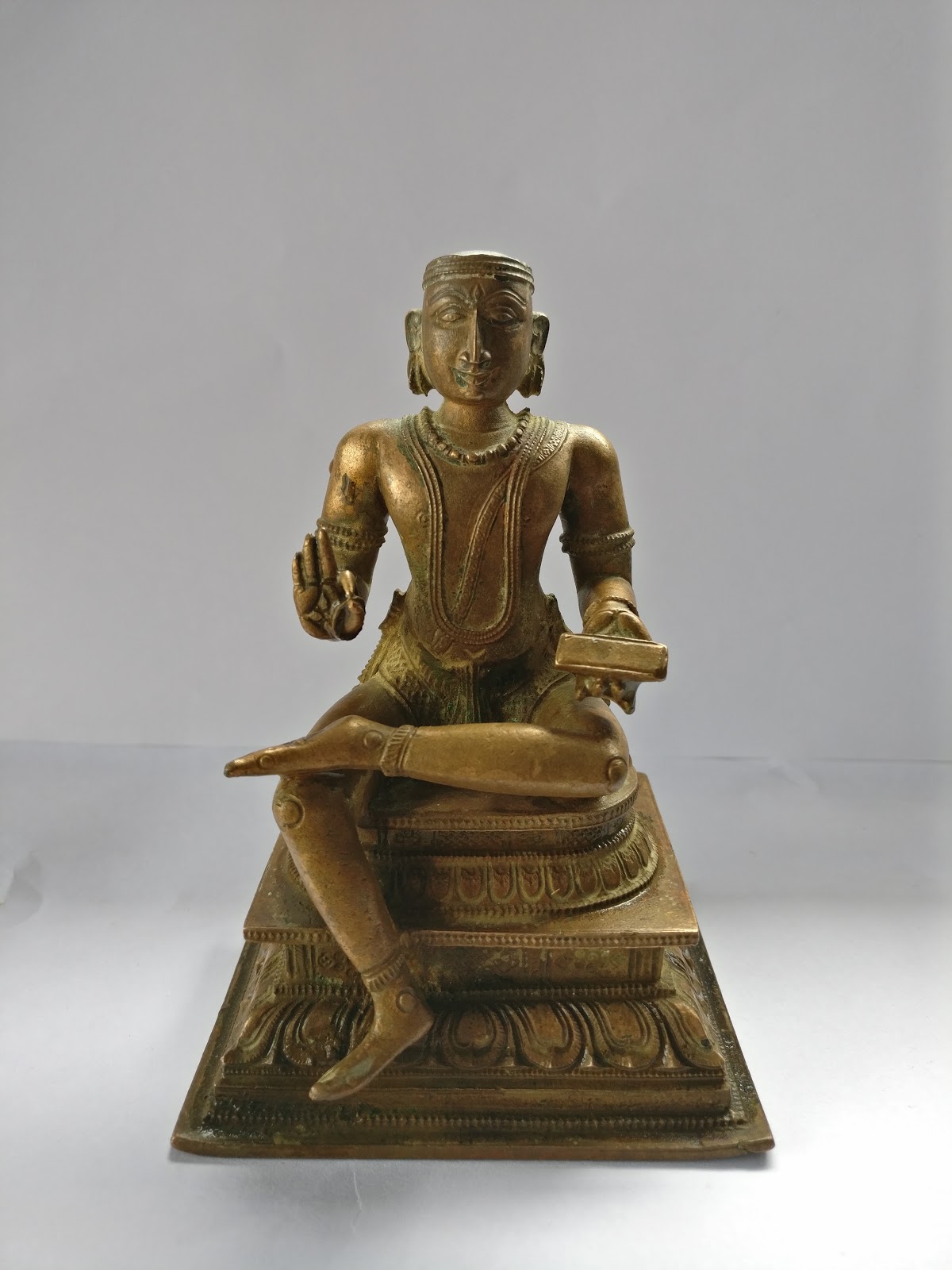
Sekkizhar was born as Arulmozhithevan, meaning “the one of the divine languages”. He was a native of Kundrathur village, a sub-division of Puliyur-kottam in Thondaimandalam. Sekkizhar was a child of precious genius and having noticed this, king Anapaya, that is King Kulothunga Chola II appointed him as his Prime Minister whose enlightened knowledge would guide the entire kingdom. His life is celebrated by the famous poet Saint Umapati Sivacharya in his fourteenth-century work (1313 A.D) called Sekkizhar Nayanar Puranam. Sekkizhar anniversary festival is celebrated every year in the Tamil month of Vaikasi (May-June) on his natal star – Poosam.
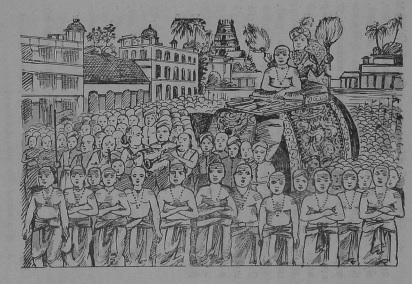
Kulothunga Chola II was so moved upon hearing Sekkizhar’s Periyapuranam that he placed the poem and Sekkizhar on the royal elephant and took them out on a grand procession around the streets of Chidambaram (spiritual nerve center in South India). The king himself waved the chamaram (fly-whisks) for Sekkizhar and showered Sekkizhar with honors. This work is considered the most important initiative of Kulothunga Chola II’s reign. Among all the hagiographic Puranas (Hindu History) in Tamil, the Periyapuranam (or Tiruttondar Puranam) stands first. The Periyapuranam is considered a fifth Veda in the Tamil language and it immediately took its place as the twelfth and the last book in the Shaiva canon.
Saint Sivaprakasar
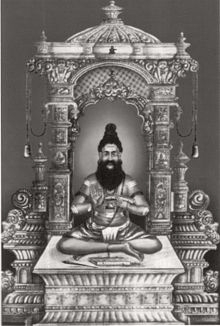
Siva Prakasar (also Ṣiva Prakāṣa or sometimes Ṣiva-prakāṣa Dēṣikar), was a Tamil poet and philosopher lived during the late 17th and early 18th centuries. He was called ‘Turai mangalam Sivaprakasar’ , ‘Karpanai Kalanjiyam’, and blessed by the grace of God as ‘Sivanuputhichelvar’. He has contributed more than thirty-four Tamil books to the Tamil Literature, the most well known of which is the ‘Nanneri’, a work dealing with moral instructions. He is also well known for translating early Kannada works into the Tamil language and for creating his own poetry.
Family Background.
Sivaprakasar was born in Kanchipuram in Thondaimandalam, into an orthodox Adi Shaiva Tamil family around the middle of the 17th Century. Sivaprakasar’s father Kumaraswamy Desikar was a respected spiritual leader. He was an archagar (official temple priest) in Thondaimandalam.
Sekkizhar’s Learning and Extraordinary Contribution to the Enlightenment Ecosystem
To learn Tamil Grammar, Sivaprakasar along with his brothers Karunaiprakasar and Velaiyar went to Tirunelveli (a place filled with enlightened beings in South India) and found Valliyur Tambiran as their teacher. The teacher accepted him as his student after Sivaprakasa Swamigal demonstrated his exceptional proficiency in the subject. He taught him everything he knew, but when Sivaprakasa Swamigal tried to pay for his tuition fees, he refused, saying that he would like to have the payment in a different sort.
The teacher had been having a bitter feud with another Tamil scholar. He told Sivaprakasa Swamigal, ‘Go to this man, defeat him in a contest of Tamil prosody, and as a condition of his defeat, make him prostrate to me’. Sivaprakasa Swamigal accepted the assignment, located the rival scholar, and challenged him to compose spontaneous verses, on a specified topic that they would both pick, that had no labial sounds in them, meaning, the verses had to be composed without any letters such as ‘m’ and ‘p’, which are sounded by putting the lips together. The scholar was unable to compose even a single verse with this restriction, whereas Sivaprakasa Swamigal produced thirty-one venbas (verses) on the prescribed theme. The rival scholar accepted defeat and went to prostrate before Sivaprakasa Swamigal’s grammar teacher – Valliyur Tambiran. Thus, to defeat such arrogant poets Sivaprakasha Swamigal sang the “Tiruchendur Neerotta YamahaAnthathi”. Sivaprakasa Swamigal travelled widely all over Tamil Nadu, met Sivagnaana Balaya Swamigal and became his first and prime disciple. He was blessed as ‘Sivanuputhichelvar’ by his Guru. He composed thirty two volumes of poetry in praise of Paramasiva and His Guru Sri Sivagnana Balaya Swamigal.
Then he went to Turaimangalam and stayed with Annamalai reddiyar, a donor and devotee of Adi Saiva. There he established monasteries – the enlightenment ecosystems – in many places particularly in Turaimangalam nearby Vaali kandapuram. He attained liberation in Nallathur near by Pondicherry when he was just thirty two.
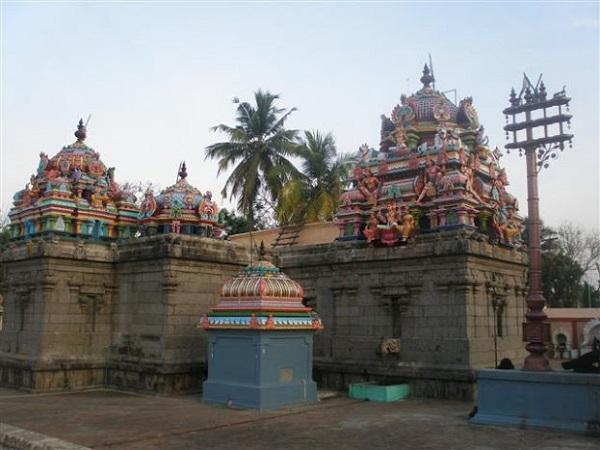
Sivaprakasa Swamigal’s jiva samadhi (place where mortal body was shed) temple
Earlier Pontiffs of the Thondaimandala Aadheenam
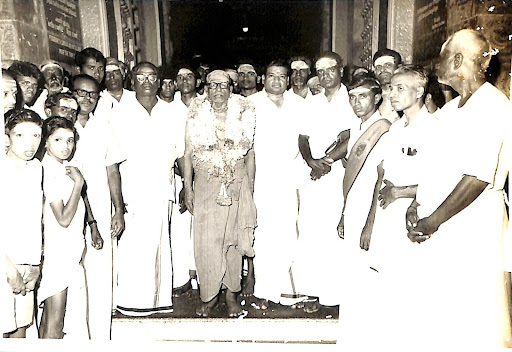
229th Pontiff of Kingdom of Thondaimandalam – Tiru Muthu Manickavasaga Mudaliar
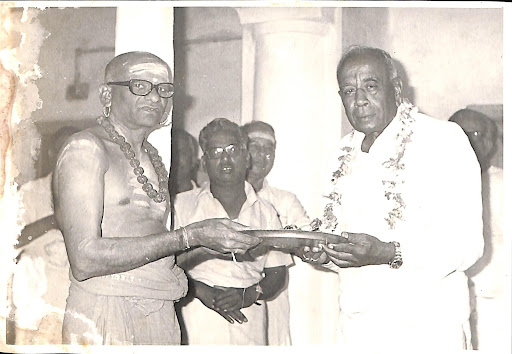
230th Pontiff of Kingdom of Thondaimandalam – Kayilai Punithar Seelathiru Jnanaprakasha Swamigal Durai – Jnanasambantha Mudaliar
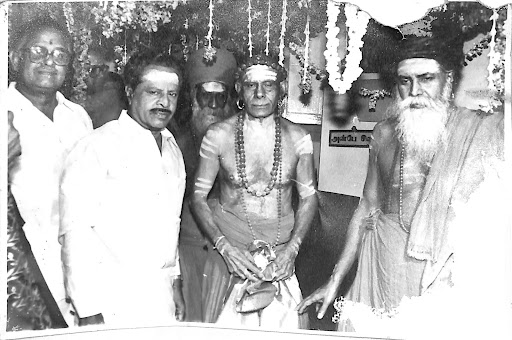
231st Pontiff of Kingdom of Thondai mandalam – Amirthaliṅga Swamigal
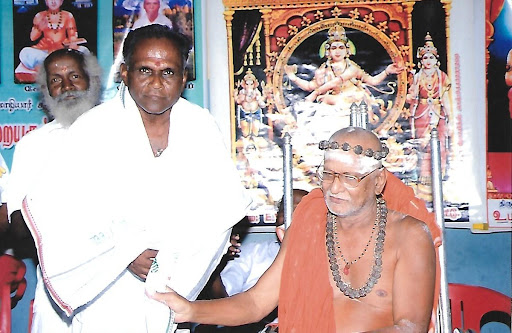
232nd Pontiff of Kingdom of Thondaimandalam – Sri La Sri Thiruvambala Desika Gnanaprakasa Swamigal
A Branch of Thondaimandalam Aadheenam Near the Famous Nellayappar Temple
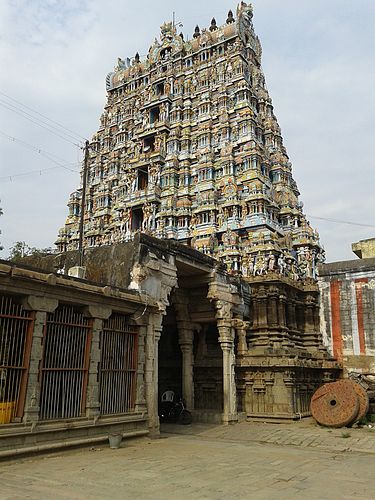
The Gopuram (temple tower) of Nellayappar temple in Tirunelveli
The famous Nellayappar temple in Tirunelveli has around it a branch of Thondaimandala Aadheenam that serves the people who visit the temple. It is a temple that is even larger than the Meenakshi Amman temple of Madurai and is a large storehouse of stone inscriptions that reveal the spiritual and political history of the place. The Aadheenam serves the devotees who visit the temple.
Thondai Mandala Shaiva Vellalars
Thondai Mandala Shaiva Vellalars (the community from which hails Bhagavan Sri Nithyananda Paramashivam) already had their kriya mutts (kriya – rituals; mutts – monasteries) to carry out their kriya activities. Each male and female was to get the Samaya Diksha (formal initiation into Adi Shaiva; Samaya – refers to the religion of Adi Shaiva; Diksha – spiritual initiation) between age 7 to 9, and receive the special Diksha before 16, accepting Anmartha Shiva Pooja (everyday personal puja each one does to a Shivalinga given to him after initiation) before marriage time and if they are keen to lead a spiritual life, they would receive the Nirvana Diksha (one more spiritual initiation) and Acharya Abhishekam (ritualistic coronation to the spiritual seat). The Thondaimandala Shaiva Vellalar community was initiated into all such initiations in early days of the enlightenment ecosystem. To assist them in these activities, they needed a Jnana Mutt (enlightenment ecosystem – a temple-monastery complex). They adapted this Adheenam (monastery) as their Jnana Peetham (spiritual Seat) and became its devotees through generations.
The Pontiffs of the Thondaimandala Aadheenam are picked from the Thondai Mandala Shaiva Vellalar community. The people of this community have made huge donations of lands and buildings at many places to this Mutt to make it a prosperous one. The history described above was seen in a book in possession with the 229th Guru Maha Sannidhanam (229th Pontiff).
Thondaimandalam and Thondaimandala Aadheenam
Kanchipuram in the State of Tamilnadu is primarily the Thondaimandala region. Hindus regard Kanchipuram in Thondaimandalam to be one of the seven holiest cities in India, the Sapta Puri (Sapta – seven; Puri – sacred place). In Hinduism, a kṣetra is a sacred ground, a field of active power, and a place where final attainment, or moksha, can be obtained. One of the Hindu Source Scriptures Garuda Purana says that seven cities, including Kanchipuram are providers of moksha (final attainment). The city is a pilgrimage site for Saivites and Vaishnavites. It has close to 108 Shiva temples. It was originally designed to stand for the ultimate Truths of Adi Shaiva and celebrate these Truths through its temples, culture, people and lifestyle.
The Guru Maha Sannidhanam (Pontiff) ruled this Adi Shaiva Kingdom from the Thondai mandala Aadheenam. Paramaśiva is the worshipped deity in this Aadheenam.
Chola Dynasty in 848-1279 AD of which Thondaimandala was a part
Pictures of the ancient Thondaimandala monastery
Pictures of the ancient Thondaimandala monastery
The presiding deity of Paramaśiva in the monastery’s temple.
Glory of Thondaimandalam
Padikasu Pulavar
Padikasu Pulavar is a Tamil poet who had lived during the late 17th and early 18th centuries. He was a native of Kalandai in Thondaimandalam. He was famous for authoring Thondaimandala Sathagam (sathagam is the name given to a composition containing one hundred verses) a poetic collection written in praise of Thondaimandala Vellalars or agriculturists of the Thondaimandalam region.
He was a court poet of Raghunatha Kilavan, first Sethupathi (Ruler) of Ramnad, South India. Sri Ramalinga Swamigal has written a fine commentary on the invocatory song of Padikasu Pulavar’s book Thondamandala Sathagam.
Xuanzang
A Chinese traveller who visited Kanchipuram in 640 CE, recorded that the city was 6 miles (9.7 km) in circumference and that its people were renowned for their bravery, piety, love of justice and veneration for learning.
Enlightened Beings and Power Manifestors of Thondaimandalam
In early days before the persecution of Kailaasa (ancient India where the civilization itself was a highly conscious and evolved one), there were enlightened beings, Siddhars, Munivars, Rishis, etc who manifested spiritual powers and kept the entire enlightenment ecosystem alive through their contributions and spiritual initiations. Below are a few such beings from ancient Thondaimandalam.
Saint Sekkizhar
Sekkizhar (Tamil: சேக்கிழார்) was a poet Saint and a contemporary of King Kulothunga Chola II in the Thondaimandalam region. He compiled and wrote the Periya Puranam (Great Story or Narrative) in 4253 verses, recounting the life stories of the sixty-three Adi Shaiva Nayanars, the enlightened devotees of Paramashiva. Sekkizhar himself was revered as a poet and Saint and his work, the Periyapuranam became the twelfth and final book of the sacred Saiva canon.
Sekkizhar was born as Arulmozhithevan, meaning “the one of the divine languages”. He was a native of Kundrathur village, a sub-division of Puliyur-kottam in Thondaimandalam. Sekkizhar was a child of precious genius and having noticed this, king Anapaya, that is King Kulothunga Chola II appointed him as his Prime Minister whose enlightened knowledge would guide the entire kingdom. His life is celebrated by the famous poet Saint Umapati Sivacharya in his fourteenth-century work (1313 A.D) called Sekkizhar Nayanar Puranam. Sekkizhar anniversary festival is celebrated every year in the Tamil month of Vaikasi (May-June) on his natal star – Poosam.
Kulothunga Chola II was so moved upon hearing Sekkizhar’s Periyapuranam that he placed the poem and Sekkizhar on the royal elephant and took them out on a grand procession around the streets of Chidambaram (spiritual nerve center in South India). The king himself waved the chamaram (fly-whisks) for Sekkizhar and showered Sekkizhar with honors. This work is considered the most important initiative of Kulothunga Chola II’s reign. Among all the hagiographic Puranas (Hindu History) in Tamil, the Periyapuranam (or Tiruttondar Puranam) stands first. The Periyapuranam is considered a fifth Veda in the Tamil language and it immediately took its place as the twelfth and the last book in the Shaiva canon.
Saint Sivaprakasar
Siva Prakasar (also Ṣiva Prakāṣa or sometimes Ṣiva-prakāṣa Dēṣikar), was a Tamil poet and philosopher lived during the late 17th and early 18th centuries. He was called ‘Turai mangalam Sivaprakasar’ , ‘Karpanai Kalanjiyam’, and blessed by the grace of God as ‘Sivanuputhichelvar’. He has contributed more than thirty-four Tamil books to the Tamil Literature, the most well known of which is the ‘Nanneri’, a work dealing with moral instructions. He is also well known for translating early Kannada works into the Tamil language and for creating his own poetry.
Family Background.
Sivaprakasar was born in Kanchipuram in Thondaimandalam, into an orthodox Adi Shaiva Tamil family around the middle of the 17th Century. Sivaprakasar’s father Kumaraswamy Desikar was a respected spiritual leader. He was an archagar (official temple priest) in Thondaimandalam.
Sekkizhar’s Learning and Extraordinary Contribution to the Enlightenment Ecosystem
To learn Tamil Grammar, Sivaprakasar along with his brothers Karunaiprakasar and Velaiyar went to Tirunelveli (a place filled with enlightened beings in South India) and found Valliyur Tambiran as their teacher. The teacher accepted him as his student after Sivaprakasa Swamigal demonstrated his exceptional proficiency in the subject. He taught him everything he knew, but when Sivaprakasa Swamigal tried to pay for his tuition fees, he refused, saying that he would like to have the payment in a different sort.
The teacher had been having a bitter feud with another Tamil scholar. He told Sivaprakasa Swamigal, ‘Go to this man, defeat him in a contest of Tamil prosody, and as a condition of his defeat, make him prostrate to me’. Sivaprakasa Swamigal accepted the assignment, located the rival scholar, and challenged him to compose spontaneous verses, on a specified topic that they would both pick, that had no labial sounds in them, meaning, the verses had to be composed without any letters such as ‘m’ and ‘p’, which are sounded by putting the lips together. The scholar was unable to compose even a single verse with this restriction, whereas Sivaprakasa Swamigal produced thirty-one venbas (verses) on the prescribed theme. The rival scholar accepted defeat and went to prostrate before Sivaprakasa Swamigal’s grammar teacher – Valliyur Tambiran. Thus, to defeat such arrogant poets Sivaprakasha Swamigal sang the “Tiruchendur Neerotta YamahaAnthathi”. Sivaprakasa Swamigal travelled widely all over Tamil Nadu, met Sivagnaana Balaya Swamigal and became his first and prime disciple. He was blessed as ‘Sivanuputhichelvar’ by his Guru. He composed thirty two volumes of poetry in praise of Paramasiva and His Guru Sri Sivagnana Balaya Swamigal.
Then he went to Turaimangalam and stayed with Annamalai reddiyar, a donor and devotee of Adi Saiva. There he established monasteries – the enlightenment ecosystems – in many places particularly in Turaimangalam nearby Vaali kandapuram. He attained liberation in Nallathur near by Pondicherry when he was just thirty two.
Sivaprakasa Swamigal’s jiva samadhi (place where mortal body was shed) temple
Earlier Pontiffs of the Thondaimandala Aadheenam
229th Pontiff of Kingdom of Thondaimandalam – Tiru Muthu Manickavasaga Mudaliar
230th Pontiff of Kingdom of Thondaimandalam – Kayilai Punithar Seelathiru Jnanaprakasha Swamigal Durai – Jnanasambantha Mudaliar
231st Pontiff of Kingdom of Thondai mandalam – Amirthaliṅga Swamigal
232nd Pontiff of Kingdom of Thondaimandalam – Sri La Sri Thiruvambala Desika Gnanaprakasa Swamigal
A Branch of Thondaimandalam Aadheenam Near the Famous Nellayappar Temple
The Gopuram (temple tower) of Nellayappar temple in Tirunelveli
The famous Nellayappar temple in Tirunelveli has around it a branch of Thondaimandala Aadheenam that serves the people who visit the temple. It is a temple that is even larger than the Meenakshi Amman temple of Madurai and is a large storehouse of stone inscriptions that reveal the spiritual and political history of the place. The Aadheenam serves the devotees who visit the temple.
Thondai Mandala Shaiva Vellalars
Thondai Mandala Shaiva Vellalars (the community from which hails Bhagavan Sri Nithyananda Paramashivam) already had their kriya mutts (kriya – rituals; mutts – monasteries) to carry out their kriya activities. Each male and female was to get the Samaya Diksha (formal initiation into Adi Shaiva; Samaya – refers to the religion of Adi Shaiva; Diksha – spiritual initiation) between age 7 to 9, and receive the special Diksha before 16, accepting Anmartha Shiva Pooja (everyday personal puja each one does to a Shivalinga given to him after initiation) before marriage time and if they are keen to lead a spiritual life, they would receive the Nirvana Diksha (one more spiritual initiation) and Acharya Abhishekam (ritualistic coronation to the spiritual seat). The Thondaimandala Shaiva Vellalar community was initiated into all such initiations in early days of the enlightenment ecosystem. To assist them in these activities, they needed a Jnana Mutt (enlightenment ecosystem – a temple-monastery complex). They adapted this Adheenam (monastery) as their Jnana Peetham (spiritual Seat) and became its devotees through generations.
The Pontiffs of the Thondaimandala Aadheenam are picked from the Thondai Mandala Shaiva Vellalar community. The people of this community have made huge donations of lands and buildings at many places to this Mutt to make it a prosperous one. The history described above was seen in a book in possession with the 229th Guru Maha Sannidhanam (229th Pontiff).
Thondaimandalam and Thondaimandala Aadheenam
Kanchipuram in the State of Tamilnadu is primarily the Thondaimandala region. Hindus regard Kanchipuram in Thondaimandalam to be one of the seven holiest cities in India, the Sapta Puri (Sapta – seven; Puri – sacred place). In Hinduism, a kṣetra is a sacred ground, a field of active power, and a place where final attainment, or moksha, can be obtained. One of the Hindu Source Scriptures Garuda Purana says that seven cities, including Kanchipuram are providers of moksha (final attainment). The city is a pilgrimage site for Saivites and Vaishnavites. It has close to 108 Shiva temples. It was originally designed to stand for the ultimate Truths of Adi Shaiva and celebrate these Truths through its temples, culture, people and lifestyle.
The Guru Maha Sannidhanam (Pontiff) ruled this Adi Shaiva Kingdom from the Thondai mandala Aadheenam. Paramaśiva is the worshipped deity in this Aadheenam.
Chola Dynasty in 848-1279 AD of which Thondaimandala was a part
Pictures of the ancient Thondaimandala monastery
Pictures of the ancient Thondaimandala monastery
The presiding deity of Paramaśiva in the monastery’s temple.
Glory of Thondaimandalam
Padikasu Pulavar
Padikasu Pulavar is a Tamil poet who had lived during the late 17th and early 18th centuries. He was a native of Kalandai in Thondaimandalam. He was famous for authoring Thondaimandala Sathagam (sathagam is the name given to a composition containing one hundred verses) a poetic collection written in praise of Thondaimandala Vellalars or agriculturists of the Thondaimandalam region.
He was a court poet of Raghunatha Kilavan, first Sethupathi (Ruler) of Ramnad, South India. Sri Ramalinga Swamigal has written a fine commentary on the invocatory song of Padikasu Pulavar’s book Thondamandala Sathagam.
Xuanzang
A Chinese traveller who visited Kanchipuram in 640 CE, recorded that the city was 6 miles (9.7 km) in circumference and that its people were renowned for their bravery, piety, love of justice and veneration for learning.
Enlightened Beings and Power Manifestors of Thondaimandalam
In early days before the persecution of Kailaasa (ancient India where the civilization itself was a highly conscious and evolved one), there were enlightened beings, Siddhars, Munivars, Rishis, etc who manifested spiritual powers and kept the entire enlightenment ecosystem alive through their contributions and spiritual initiations. Below are a few such beings from ancient Thondaimandalam.
Saint Sekkizhar
Sekkizhar (Tamil: சேக்கிழார்) was a poet Saint and a contemporary of King Kulothunga Chola II in the Thondaimandalam region. He compiled and wrote the Periya Puranam (Great Story or Narrative) in 4253 verses, recounting the life stories of the sixty-three Adi Shaiva Nayanars, the enlightened devotees of Paramashiva. Sekkizhar himself was revered as a poet and Saint and his work, the Periyapuranam became the twelfth and final book of the sacred Saiva canon.
Sekkizhar was born as Arulmozhithevan, meaning “the one of the divine languages”. He was a native of Kundrathur village, a sub-division of Puliyur-kottam in Thondaimandalam. Sekkizhar was a child of precious genius and having noticed this, king Anapaya, that is King Kulothunga Chola II appointed him as his Prime Minister whose enlightened knowledge would guide the entire kingdom. His life is celebrated by the famous poet Saint Umapati Sivacharya in his fourteenth-century work (1313 A.D) called Sekkizhar Nayanar Puranam. Sekkizhar anniversary festival is celebrated every year in the Tamil month of Vaikasi (May-June) on his natal star – Poosam.
Kulothunga Chola II was so moved upon hearing Sekkizhar’s Periyapuranam that he placed the poem and Sekkizhar on the royal elephant and took them out on a grand procession around the streets of Chidambaram (spiritual nerve center in South India). The king himself waved the chamaram (fly-whisks) for Sekkizhar and showered Sekkizhar with honors. This work is considered the most important initiative of Kulothunga Chola II’s reign. Among all the hagiographic Puranas (Hindu History) in Tamil, the Periyapuranam (or Tiruttondar Puranam) stands first. The Periyapuranam is considered a fifth Veda in the Tamil language and it immediately took its place as the twelfth and the last book in the Shaiva canon.
Saint Sivaprakasar
Siva Prakasar (also Ṣiva Prakāṣa or sometimes Ṣiva-prakāṣa Dēṣikar), was a Tamil poet and philosopher lived during the late 17th and early 18th centuries. He was called ‘Turai mangalam Sivaprakasar’ , ‘Karpanai Kalanjiyam’, and blessed by the grace of God as ‘Sivanuputhichelvar’. He has contributed more than thirty-four Tamil books to the Tamil Literature, the most well known of which is the ‘Nanneri’, a work dealing with moral instructions. He is also well known for translating early Kannada works into the Tamil language and for creating his own poetry.
Family Background.
Sivaprakasar was born in Kanchipuram in Thondaimandalam, into an orthodox Adi Shaiva Tamil family around the middle of the 17th Century. Sivaprakasar’s father Kumaraswamy Desikar was a respected spiritual leader. He was an archagar (official temple priest) in Thondaimandalam.
Sekkizhar’s Learning and Extraordinary Contribution to the Enlightenment Ecosystem
To learn Tamil Grammar, Sivaprakasar along with his brothers Karunaiprakasar and Velaiyar went to Tirunelveli (a place filled with enlightened beings in South India) and found Valliyur Tambiran as their teacher. The teacher accepted him as his student after Sivaprakasa Swamigal demonstrated his exceptional proficiency in the subject. He taught him everything he knew, but when Sivaprakasa Swamigal tried to pay for his tuition fees, he refused, saying that he would like to have the payment in a different sort.
The teacher had been having a bitter feud with another Tamil scholar. He told Sivaprakasa Swamigal, ‘Go to this man, defeat him in a contest of Tamil prosody, and as a condition of his defeat, make him prostrate to me’. Sivaprakasa Swamigal accepted the assignment, located the rival scholar, and challenged him to compose spontaneous verses, on a specified topic that they would both pick, that had no labial sounds in them, meaning, the verses had to be composed without any letters such as ‘m’ and ‘p’, which are sounded by putting the lips together. The scholar was unable to compose even a single verse with this restriction, whereas Sivaprakasa Swamigal produced thirty-one venbas (verses) on the prescribed theme. The rival scholar accepted defeat and went to prostrate before Sivaprakasa Swamigal’s grammar teacher – Valliyur Tambiran. Thus, to defeat such arrogant poets Sivaprakasha Swamigal sang the “Tiruchendur Neerotta YamahaAnthathi”. Sivaprakasa Swamigal travelled widely all over Tamil Nadu, met Sivagnaana Balaya Swamigal and became his first and prime disciple. He was blessed as ‘Sivanuputhichelvar’ by his Guru. He composed thirty two volumes of poetry in praise of Paramasiva and His Guru Sri Sivagnana Balaya Swamigal.
Then he went to Turaimangalam and stayed with Annamalai reddiyar, a donor and devotee of Adi Saiva. There he established monasteries – the enlightenment ecosystems – in many places particularly in Turaimangalam nearby Vaali kandapuram. He attained liberation in Nallathur near by Pondicherry when he was just thirty two.
Sivaprakasa Swamigal’s jiva samadhi (place where mortal body was shed) temple
Earlier Pontiffs of the Thondaimandala Aadheenam
229th Pontiff of Kingdom of Thondaimandalam – Tiru Muthu Manickavasaga Mudaliar
230th Pontiff of Kingdom of Thondaimandalam – Kayilai Punithar Seelathiru Jnanaprakasha Swamigal Durai – Jnanasambantha Mudaliar
231st Pontiff of Kingdom of Thondai mandalam – Amirthaliṅga Swamigal
232nd Pontiff of Kingdom of Thondaimandalam – Sri La Sri Thiruvambala Desika Gnanaprakasa Swamigal
A Branch of Thondaimandalam Aadheenam Near the Famous Nellayappar Temple
The Gopuram (temple tower) of Nellayappar temple in Tirunelveli
The famous Nellayappar temple in Tirunelveli has around it a branch of Thondaimandala Aadheenam that serves the people who visit the temple. It is a temple that is even larger than the Meenakshi Amman temple of Madurai and is a large storehouse of stone inscriptions that reveal the spiritual and political history of the place. The Aadheenam serves the devotees who visit the temple.